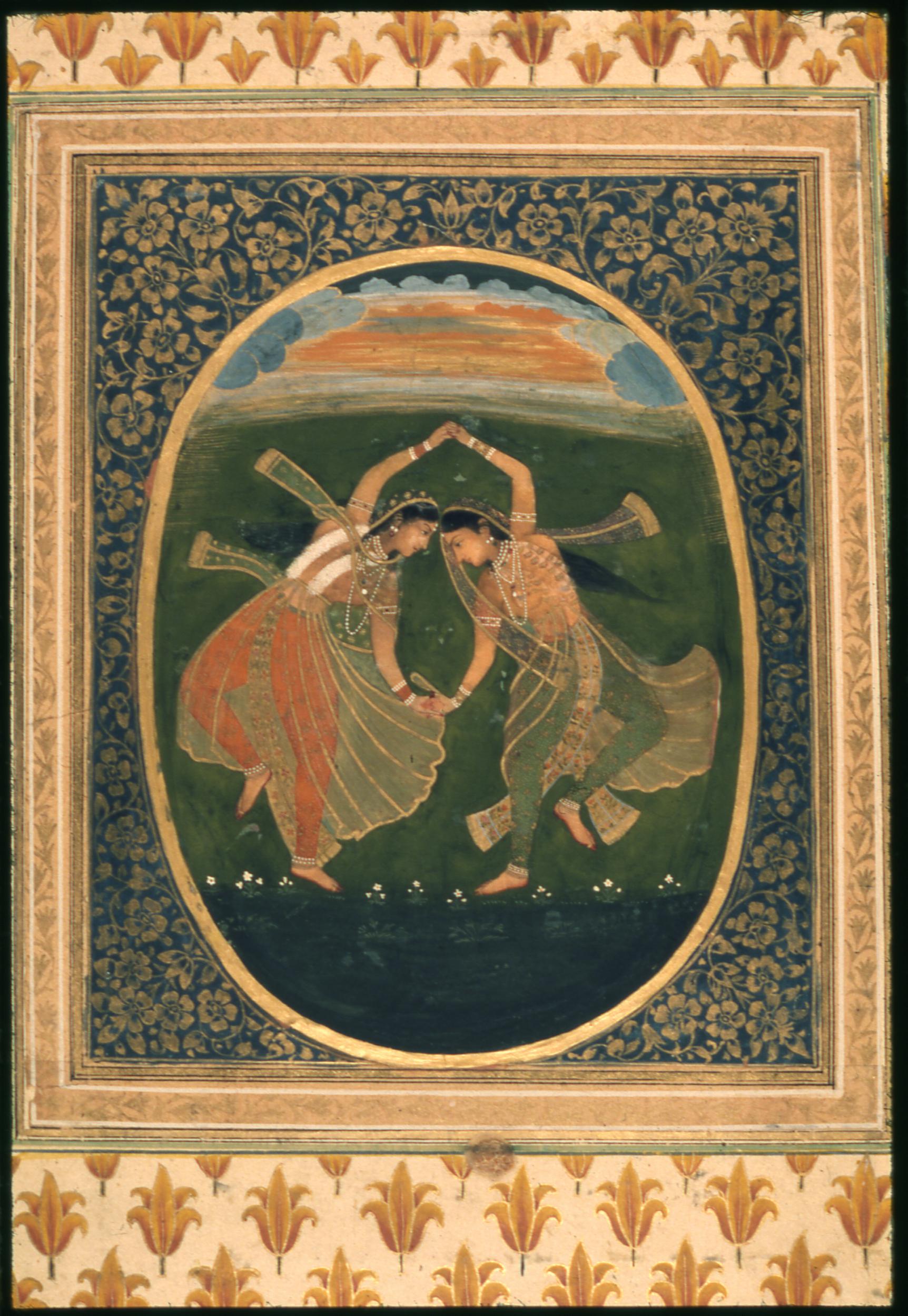
Album Leaf (recto), Recreation, “Two women dancers”, circa 1650-1750, On Paper, The British Museum 1974,0617,0.21.54 © The Trustees of the British Museum. Shared under a Creative Commons Attribution-NonCommercial-ShareAlike 4.0 International (CC BY-NC-SA 4.0) licence.
Material histories of courtesanship, 1700-1900
Infrastructures of Courtesanship is a research project supported by the Durham University Seedcorn Fund (2026). The main objectives of the project are to reconstruct the material, architectural, and visual worlds of courtesans in South Asia (c.1700–2000), analyse how built environments shaped performance, patronage, and sociability and to evelop interdisciplinary methods combining archival, visual, and digital approaches.
Meet the Researchers
Dr. Radha Kapuria
Principal Investigator
Durham University
Dr Radha Kapuria is Associate Professor in South Asian History at Durham University, UK, with research interests in performance, gender, migration and cultural histories. Her first book, Music in Colonial Punjab: Courtesans, Bards, and Connoisseurs (Oxford 2023), received a Special Mention at the Karwaan Book Award 2024. Her most recent publications include a co-authored article in the Special Issue on ‘The Travelling Female Performer: mobility and agency in and beyond South Asia, circa 1760–1940’, which she has co edited for the Journal of the Royal Asiatic Society.
Dr. Parshati Dutta
Dr Parshati Dutta is an architect and a cultural heritage conservation consultant who recently completed her PhD on architectural matronage in Mughal India at the University of York, funded by the University and the British Institute of Persian Studies. Her work has been published in journals like South Asia, Religions of South Asia, and the International Journal of Islamic Architecture, and several edited collections.
Updates
News, events, and research highlights from the project.

